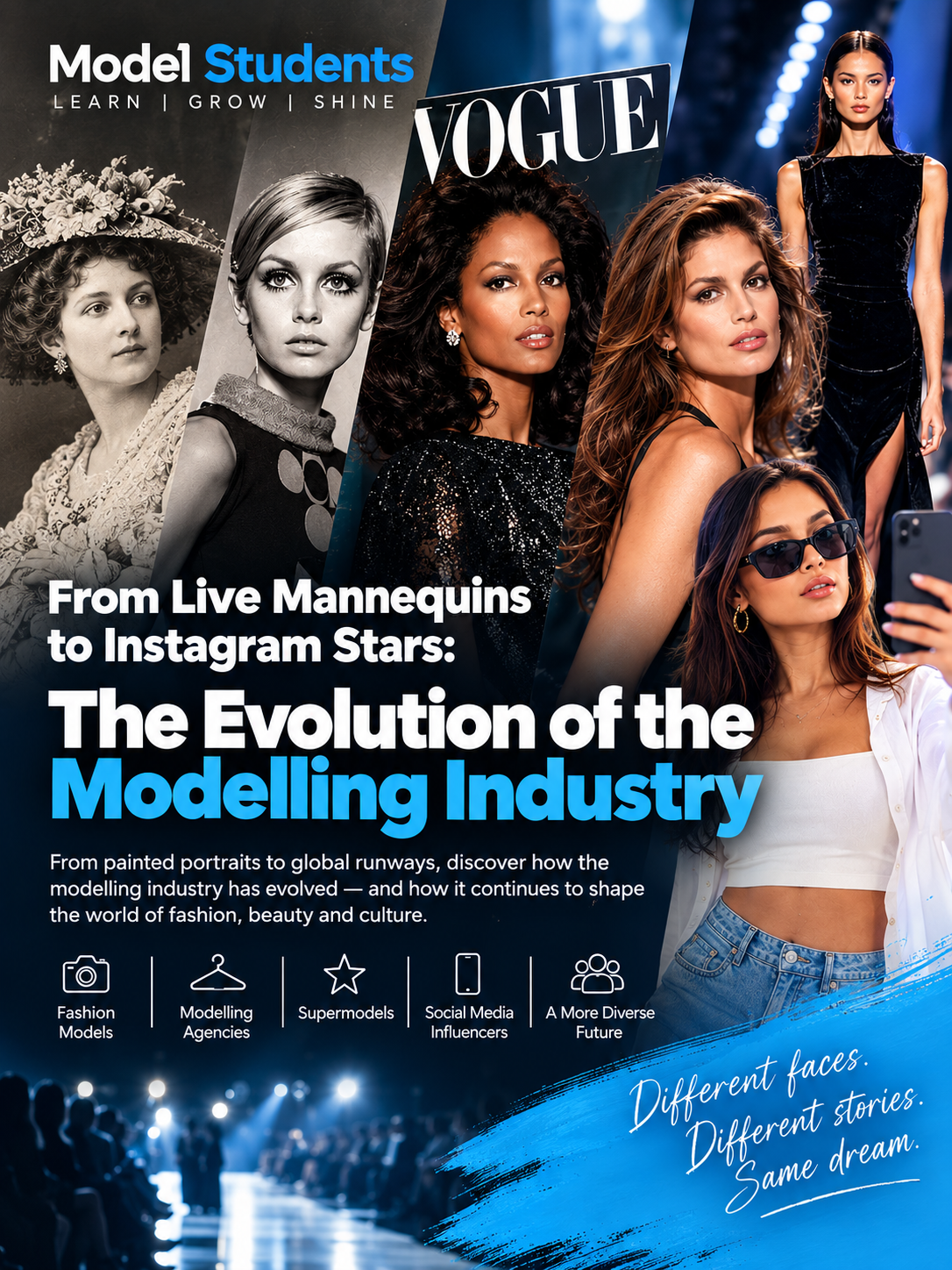

From Painted Portraits to Digital Fame
What does it mean to be a model today?
For some, it means walking the runway for an international fashion brand. For others, it might mean
appearing in a magazine, starring in an advertising campaign, creating beauty content or building a
personal brand on social media.
But modelling wasn't always the global, glamorous and highly competitive industry we know today.
The history of modelling stretches back centuries and has evolved alongside art, photography,
fashion, advertising, popular culture and technology.
At Model Students, we decided to explore how modelling began, how the profession developed and
how today's models are helping shape the future of the industry
The Origins of Modelling
The word “modelling” is associated with the Middle French word modelle, meaning a representation or
example.
1The concept of modelling existed long before fashion runways and magazine covers. Artists regularly
used people as subjects for paintings and portraits, creating an early form of modelling.
The invention and development of photography during the 19th century changed everything.
For the first time, people's appearances could be captured and reproduced in photographs. As
newspapers, magazines and advertising developed, photographs became an increasingly important
way of presenting people, products and fashion.
This helped create the foundations of modern fashion modelling.
Marie Augustine Vernet and the First Fashion Models
One of the earliest people associated with professional fashion modelling was Marie Augustine
Vernet, the wife of celebrated French fashion designer Charles Frederick Worth.
She is widely credited in popular accounts as one of the first fashion models to help showcase a
designer's clothing.
Before human models became commonplace, fashion retailers primarily used mannequins to display
garments. Human models were sometimes referred to as “live mannequins.”
Initially, the role was largely practical. Models demonstrated how clothing looked when worn, helping
customers understand the design, shape and fit of garments.
The profession would eventually become much more than simply displaying clothes.
The Rise of Professional Modelling Agencies
The modelling industry began to develop rapidly during the 20th century.
A major milestone came in 1946, when Eileen and Gerard Ford founded Ford Models. The agency
became one of the pioneering names in professional modelling and helped establish agency
representation as an important part of a model's career.
As the agency system developed, modelling became increasingly professionalised.
Agencies could connect models with:
• Fashion designers
• Photographers
• Magazines
• Advertising
• companies
• Clothing brands
Casting directors
By the 1960s, modelling agencies were appearing in major fashion centres around the world.
The 1960s: London Becomes a Fashion Hub
The 1960s brought an explosion of creativity to fashion.
London became one of the world's important fashion centres, with a new generation of designers,
photographers and models helping to define the decade.
One of the most recognisable faces of the era was Twiggy, whose distinctive look became an
international symbol of 1960s fashion.
The role of models was also changing.
Models were increasingly expected to bring personality, confidence and movement to their work.
Fashion shows became entertainment experiences, and models had to do more than simply display
clothing.
The 1970s and 1980s: Breaking Barriers
The following decades brought important changes to the modelling profession.
Models increasingly gained better opportunities, improved working conditions and greater recognition
as professional performers.
Diversity also began receiving greater attention.
3
A landmark moment occurred in 1974, when Beverly Johnson became the first African-American
model to appear on the cover of American Vogue.
Her achievement represented an important moment in fashion history and helped increase visibility for
Black models within the mainstream fashion industry.
At the same time, modelling was becoming increasingly international. Models could travel between
major fashion capitals, working on runway shows, magazine editorials and advertising campaigns.
The 1990s: The Supermodel Era
If the 1960s created fashion icons, the 1990s created global superstars.
Models such as Naomi Campbell, Cindy Crawford, Linda Evangelista and Christy Turlington became
household names.
The term “supermodel” became part of popular culture.
These models appeared in fashion magazines, television programmes, advertising campaigns and
major fashion shows. Their fame extended far beyond the runway, turning modelling into a form of
celebrity culture.
Fashion was also becoming increasingly connected to music and entertainment.
Pop stars such as Britney Spears and Christina Aguilera influenced youth fashion during the decade,
demonstrating the growing relationship between music, celebrity culture and fashion trends.
The Digital Revolution: Modelling Meets Social Media
The biggest transformation may have come with the arrival of the internet and social media.
Today, a modelling career doesn't necessarily begin with a traditional agency.
4 Platforms such as Instagram and TikTok allow aspiring models and creators to showcase their
appearance, personality, fashion sense and creativity directly to audiences.
This has created a new type of model: the social media model and influencer.
A person can build an audience, collaborate with brands and create commercial opportunities without
following the traditional career path.
For many aspiring models, social media has become an important tool for personal branding,
networking and portfolio building.
A More Diverse Modelling Industry
Modern modelling is also challenging traditional ideas about what a model should look like.
The industry increasingly features people with different:
• Physical
• Personal styles
• backgrounds
• Ethnic
• Ages
• Body types
characteristics
Cultural backgrounds
This broader representation reflects a changing audience and a growing demand for authenticity.
For aspiring models, this means there may be more opportunities across different areas of the industry
—including fashion, commercial modelling, beauty, fitness, lifestyle, e-commerce and social
media.
What Does It Mean to Be a Model Today?
The modern modelling career can take many different forms.
5 A model might work on:
Runway modelling — showcasing clothing during fashion shows.
Editorial modelling — appearing in magazines and creative fashion photography.
Commercial modelling — promoting products and services through advertising.
E-commerce modelling — showcasing clothing and products for online stores.
Beauty modelling — working with cosmetics, skincare and beauty brands.
Fitness modelling — appearing in fitness, sports and wellness campaigns.
Social media modelling — creating content and building an audience through digital platforms.
For aspiring models, understanding these different opportunities can be an important first step
towards building a sustainable career.
The Future of Modelling
From painted portraits to photography, live mannequins to professional agencies, supermodels to
social media creators, the modelling industry has continually evolved.
Technology has changed how models are discovered. Social media has changed how they build
audiences. And changing attitudes about beauty and representation are influencing who gets seen and
celebrated.
One thing is certain: modelling is no longer defined by a single look, career path or platform.
The next generation of models has the opportunity to bring something different to the industry—
personality, creativity, confidence and individuality.
Different Faces. Different Stories. Same Dream.
At Model Students, we believe modelling is about more than appearance.
It's about learning how to present yourself, developing confidence, understanding the industry and
discovering your own potential.
The modelling industry has come a long way.
And its next chapter could belong to you.